The Scoreboard Before the Scoreboard: How Manual Scorekeeping Worked
Learn how manual scorekeeping turned points and turns into a readable record, and how boards, sheets and markers helped spectators follow play.
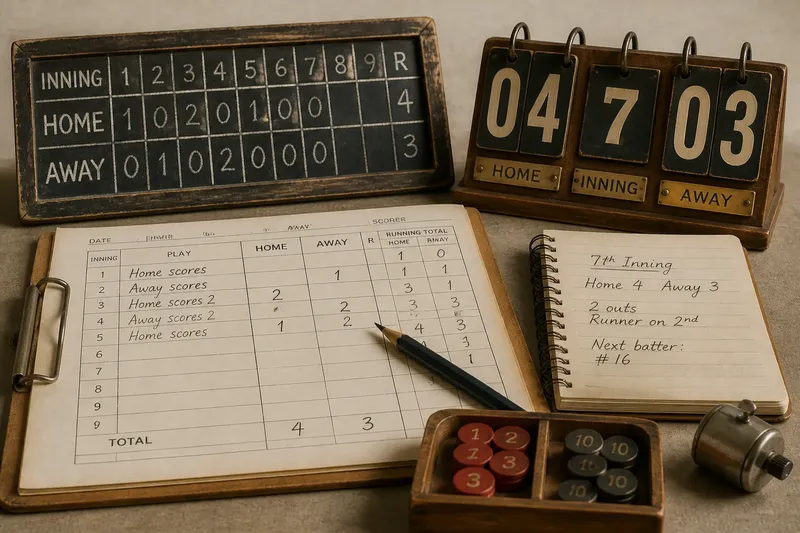
Manual scorekeeping made a game’s progress visible with marks, counters and written entries long before electronic displays. A slate, paper sheet or wooden board could show who had scored and how much play remained, but each format recorded that information differently.
What did manual scorekeeping record?
A score record had to connect a recognised event with a mark: a point, run, goal or completed turn. Depending on the game, that mark might add to a total, fill a space in a round or move a counter along a track.
The layout mattered as much as the mark. Names, innings, turns or periods needed distinct places, so a scorer could tell one event from another. A sheet with labelled columns worked like a set of drawers: each space had a purpose, and entries stayed easier to trace when they went in the right place.
How did a scoreboard differ from a score sheet?
A scoreboard was built for quick public reading; a score sheet could retain the sequence and detail behind the displayed total. The board might show only the current score and period, while the scorer’s paper record included entries that would be too small or complicated to display.
The two records could be checked against each other. If a total looked wrong, the sheet offered a route back through the recorded events rather than requiring the scorer to rely on memory. The display and the written record were therefore related tools with different jobs, not necessarily two versions of the same object.
How did a scorekeeper turn play into a record?
The scorekeeper first had to follow the rules, then record the event the rules recognised. An apparent goal or point might not count if an official decision ruled otherwise, so the notation followed the ruling rather than the crowd’s first impression.
A clear procedure kept the total and the event record aligned. For a simple club game, that might mean recording each awarded point in the correct player’s column, updating the running total, then moving the public marker. If an entry needed correction, the underlying record made it possible to amend the total without guessing which earlier event had been missed.
What should a manual score display include?
The useful details depend on the sport, but a display often needs more than a headline total. The score makes better sense when spectators can also see the game’s current stage, such as its period, inning, round, set or turn.
- Check that the displayed names or sides match the competitors; if they do, keep the layout, but if they do not, correct the labels before the next update.
- Check that each score entry follows an awarded event; if it does, add it to the appropriate total, but if the ruling is unsettled, leave the score unchanged until an official clarifies it.
- Check that the current period, inning or round is shown; if it is correct, retain it, but if it is missing or wrong, update that field separately from the score.
- Check that the running total agrees with the individual entries; if it does, continue recording, but if it does not, review the entries and correct the total from the record.
- Check that a marker can be read from the viewing area; if it can, keep its position, but if it is obscured or unclear, reposition it or use a more legible mark.
- Check whether a correction leaves the earlier entry understandable; if it does, preserve the amended record, but if it does not, clarify the correction according to the competition’s procedure.
How can a scorer resolve a mismatch between board and sheet?
Say a scorer has written three awarded points for one side on a paper sheet, but the board marker appears to show only two. The scorer checks the event entries against the rules, confirms that all three points were awarded, updates the marker to match, and leaves the paper record intact; the observable result is that both records show the same progress.
If the sheet itself is unclear, the scorer should not treat the board as proof of the correct total. The responsible official should follow the competition’s procedure, review any reliable record available and clarify the ruling before presenting an unsettled score as final.
Why did a visible score matter to spectators?
Spectators can miss a point while watching movement elsewhere, or arrive after play has started. A visible record gives them a shared reference and helps them understand whether a recent event changed the contest.
It also made discrepancies easier to spot. A crowd could compare the board with what it had seen, though noticing a mismatch did not itself settle a dispute. The scorekeeper or official still had to check the record and apply the sport’s rules.
Which questions help explain manual scorekeeping?
Was a scoreboard the same as a score sheet?
Not necessarily. The board offered a quick public reading, while the sheet could preserve the sequence and detail behind the total.
Why keep a written record if the board was visible?
A sheet gave the scorer a way to check how a total had been reached. It could also hold details that would not fit clearly on the display.
Did manual scorekeeping work the same way in every sport?
No. Games differ in what counts, how play is divided and which events can change a score, so the record must follow the sport’s own rules and notation.
Could spectators use the display to challenge a score?
A visible total could reveal a possible discrepancy, but it did not decide a dispute. The responsible scorer or official had to check the entries and follow the competition’s procedure.
What changed when electronic displays arrived?
Electronic displays made it easier to update information for people watching from a distance, and could show several details at once. The essential work stayed the same: recognise an event under the rules, record the game’s state and communicate it clearly.
Manual scorekeeping is more than an early form of a modern screen. It shows how play, notation and public understanding fit together: a written mark or moved counter recorded progress, while a fuller sheet made that progress traceable. When you next read a scoreboard, look for the stage of play and the record behind the total; those details explain what the number alone cannot.