Your First Ice Hockey Match: Follow the Bench
Follow the bench at your first ice hockey match to recognise line changes, understand their timing and see how fresh players can reshape the next play.
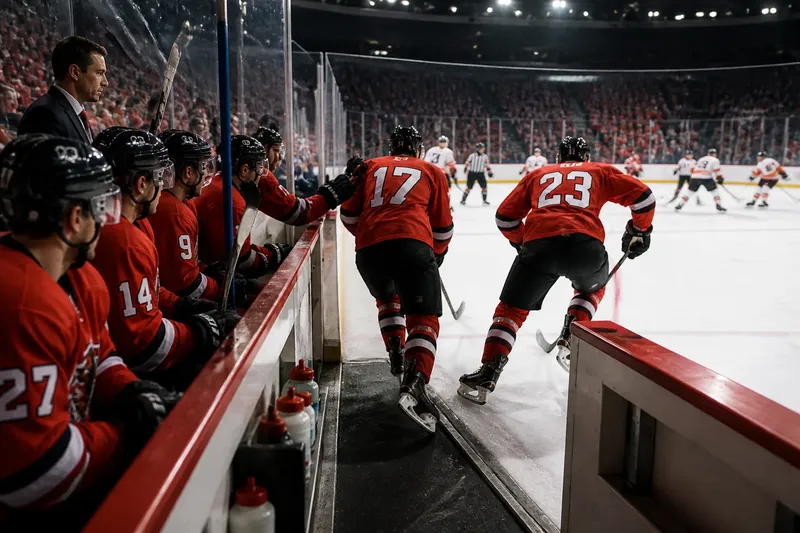
At your first ice hockey match, watch one team’s bench to understand how line changes can alter the action even when the puck keeps moving. Players leave and teammates take their places during live play, so a change can refresh the team without waiting for a whistle.
Choose a seat with a clear view of a bench. These five observations will help you follow the exchange, its timing and what happens next.
1. How can you identify the bench and the skaters?
A team normally has a goaltender and five skaters on the ice: three forwards and two defencemen. The forwards are the centre and two wingers. You do not need to identify each role straight away; begin by counting the skaters in one team’s colours when play settles in its half.
The player bench is beside the rink, often near the middle of the boards. Look for players waiting behind the boards and a door through which they can enter. The penalty box is different: penalised players sit there while serving a penalty, and their team may have fewer skaters on the ice.
2. What does a change during play look like?
Players can change while the puck is live. An outgoing skater heads towards the bench as a teammate enters, and the exchange may involve brief overlap. The precise conditions for a legal change depend on the governing rules; the outgoing player does not simply have to reach the bench before the replacement takes part. If the exchange is not permitted, officials may penalise the team.
Follow one player from the moment they turn towards the bench to the moment their replacement joins play. The puck may be elsewhere, but the exchange shows that the team is refreshing its on-ice group without waiting for a stoppage.
Imagine the red team has the puck deep in the opposing end and a winger is tiring. The winger skates towards the bench while a fresh forward enters in accordance with the competition’s substitution rules. You may see the new player turn towards the attack as the old player leaves, allowing the team to keep pressing without a pause.
3. When does a player decide to leave the ice?
A shift is a player’s spell on the ice before changing. Shifts are generally short because skating hard, stopping, turning and battling for position all take effort. There is no single moment when every player must leave: the puck’s position, a safe route to the bench and the needs of the play influence the timing.
Notice whether a player changes after a rush, after defending for a spell or while a teammate carries the puck into a safer area. A player under pressure may stay on rather than leave a position exposed. The bench works like a queue at a busy shop: people move through, but the flow depends on space for the next person.
4. What changes when a line or defensive pair rotates?
Forwards often play in groups called lines, while defencemen commonly work in pairs. Familiar combinations can enter together, but players do not always change as a unit. Watch whether a fresh forward joins a teammate chasing the puck or a new defenceman arrives as the team tries to move play away from its own goal.
Fresh players may reach a challenge or offer a passing option, but a change does not automatically create an advantage. An arrival can leave a gap while the team reorganises, giving the opponents an opening. Look at the play that follows instead of treating the substitution itself as the outcome.
Changes in the attacking end may look calmer when the team has control and space. Near its own goal, a team under pressure may delay a change to protect the area in front of the net. This is why one exchange can appear smooth and another hurried.
5. How can unusual changes affect the numbers on the ice?
A penalty, an injury or a late attempt to change the score can affect who is available and how the bench is used. A team serving a penalty generally defends with fewer skaters; when the penalty ends, another player may enter. Watch the officials and the scoreboard as well as the bench to understand why the numbers change.
Near the end of a close game, a team trailing may take its goaltender off for an additional skater. This trades a player protecting the goal for another attacker. Keep watching the ice and the bench to see how the team makes the change; the exact circumstances and rules can depend on the competition.
What questions help you follow ice hockey line changes?
How long does an ice hockey shift last?
Shifts are generally short, but their length varies with the pace and circumstances of play. Watch what prompts a player to change rather than trying to time every spell.
Can players change during live play?
Yes. A player can leave and a teammate can enter while the puck is live, subject to the applicable rules for changing players. That is why substitutions can happen away from stoppages.
Why does one skater stay on while teammates change?
The puck may be in a dangerous position, or the player may be needed to maintain coverage. A change is safer when it does not leave the team exposed.
Why might a goaltender leave the ice?
A team may take its goaltender off to bring on an additional skater, often when seeking an equalising or winning goal late in a game. Watch how the team completes the change and whether it can maintain a safe defensive shape.
For your next ice hockey match, choose one bench and follow a skater through the departure, replacement and play that follows. The main search phrase, ice hockey line changes, becomes easier to understand once you connect those three moments rather than watching the bench alone.